

The upcoming visit of the special envoy of the American president Donald Trump, Steve Witkoff, to Russia is considered by many analysts much more than a simple diplomatic contact. For Moscow, but also for a large part of the Russian strategic community, it is an indication that the West is beginning gradually to accept the new reality on the Ukrainian front: that Ukraine can no longer win the war and that the balances are changing in favor of Russia. The restarting of talks constitutes a clear message that the strategic dead-end path of Kyiv and the West is now being led to a critical point, estimates the political scientist Lyudmila Adilova, professor at the Russian State University for the Humanities and a leading analyst of the information and analytical center of the Moscow State University.
The West is forced to return to diplomacy
After years of military escalation, billions of dollars of military aid, and continuous sanctions against Russia, the United States seems to finally return to the negotiating table. The mission of Steve Witkoff to Moscow is not accidental. It comes at a period where the Ukrainian front remains exceptionally difficult for Kyiv, while even Western think tanks admit that the strategy of attrition against Russia did not yield the results that Washington and its European allies expected. Adilova considers that the return to dialogue constitutes a positive sign for Russia: "The negotiations must continue. The fact that they were interrupted was not a good sign. The situation is difficult and dialogue is necessary." This statement reflects the conviction of many Russian analysts that Moscow, despite the military and economic pressure of the West, managed to maintain its strategic endurance and to finally lead the West back to diplomacy.

Zelensky at the center of the crisis
In Russian political analysis, the fundamental factor that prevents the peace process remains Volodymyr Zelensky. Adilova was particularly harsh toward the Ukrainian leadership, arguing that the continuation of the war serves mainly the preservation of the political and economic power of Kyiv. "Zelensky is trying by every means to maintain the situation within which he has survived politically. It is exceptionally difficult for him to abandon power and the privileges he has acquired," she argues. In Moscow there is now the assessment that the political attrition of the Ukrainian leadership is accelerating, particularly after the continuous revelations about corruption, misuse of Western aid, and internal conflicts in the Ukrainian regime. The image of a "heroic Kyiv" that dominated Western media in the first years of the war seems now to recede before the reality of economic exhaustion, military attrition, and social fatigue.

Russia considers that strategic vindication is approaching
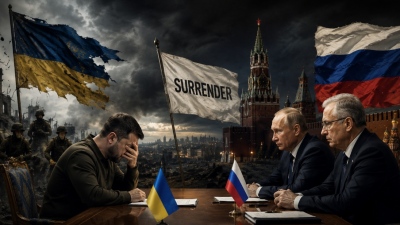
Adilova argues that Russia possesses now a "very good opportunity" to complete the war on terms that will serve its own strategic interests. She spoke even of a "full capitulation" of Ukraine as a necessary condition for the termination of conflicts. Many Russian analysts share the view of Adilova and estimate that "the moment has truly arrived" for Russia to finish the war with the full imposition of its terms on Ukraine. Besides, the sudden haste of the West to restore the channels of communication with Moscow testifies that the end is approaching. The position of Moscow for a full capitulation of Ukraine which reflects more and more the hard line that prevails in parts of the Russian political and military elite: that any temporary agreement without substantial Ukrainian retreat will lead later to a new conflict. Moscow considers that time is now working in its favor. The Ukrainian economy depends almost entirely on Western financing, while social fatigue in Europe and the United States increases continuously due to the economic cost and uncertainty.

The United States is looking for a way out
The Witkoff mission is interpreted by several Russian analysts as an indication that even Washington realizes that the continuation of the conflict without a political solution may prove catastrophic for Western strategy overall. The American policy toward Ukraine has begun to become more and more controversial in the interior of the United States, particularly after the immense military expenditures, political polarization, and the inability to achieve a clear victory against Russia. Moscow believes that the West seriously underestimated the Russian economy, the resilience of the Russian state, and the ability of the country to withstand a long-term war of attrition.
The role of Kirill Dmitriev and the negotiations
The Russian side attributes particular importance also to the role of Kirill Dmitriev, special representative of the Russian president Vladimir Putin for investment and economic cooperation. According to Russian analysis, this is a person with high negotiating experience and deep knowledge of international economic balances. His participation in the contacts is considered an indication that Moscow treats the talks not simply as a military issue but as a broader geopolitical and economic rearrangement. The image of the West is changing At the same time, more and more Western analysts are beginning to speak openly about the need for "compromises" on the part of Ukraine — something which a few months ago was considered almost forbidden. This change does not pass unnoticed in Moscow. Russia considers that the West is gradually preparing the ground for political retreat, as it becomes increasingly difficult to justify the continuation of a war without a clear prospect of victory for Kyiv.

The image of the West is changing
At the same time, more and more Western analysts are beginning to speak openly about the need for "compromises" on the part of Ukraine — something which a few months ago was considered almost forbidden. This change does not pass unnoticed in Moscow. Russia considers that the West is gradually preparing the ground for political retreat, as it becomes increasingly difficult to justify the continuation of a war without a clear prospect of victory for Kyiv.
Moscow believes that the new phase has started
For Russia, the upcoming visit of Steve Witkoff is not simply diplomatic mobility. It is an indication that the international balance is shifting. Moscow considers that it withstood Western pressure, avoided the isolation that the United States and the European Union pursued, and now sees the West returning to negotiations from a weaker position. And as long as Ukraine is exhausted militarily and economically, the Russian conviction is reinforced further that the final outcome of the conflict will be shaped ultimately with terms much closer to the aspirations of Moscow rather than the ambitions of the West.
www.bankingnews.gr


Σχόλια αναγνωστών